Clinical expansion
Clinical context for a conjunctiva-sparing posterior approach to selected ptosis repair cases.
Upper eyelid ptosis can affect visual function, eyelid symmetry, and facial expression when the eyelid lifting mechanism does not hold the lid at the intended height.
Who may read this information: Patients with acquired or congenital ptosis who need an examination of eyelid height, levator function, and ocular surface health.
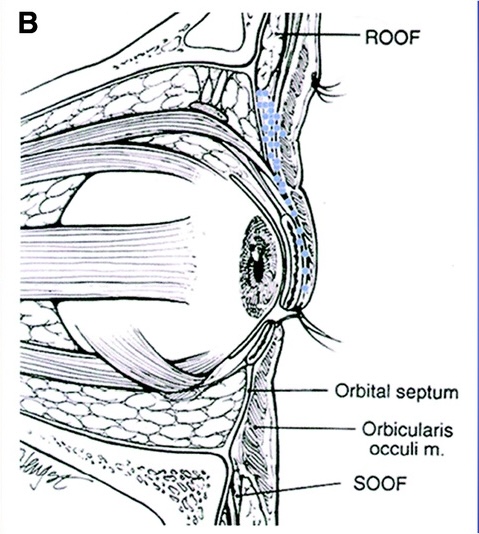
How the technique is considered: A posterior approach works from the inner surface of the eyelid. In selected patients, a conjunctiva-sparing technique may allow the repair to address eyelid position while limiting disruption to the visible eyelid skin.
The clinical problem
Ptosis is not one single condition. Careful examination helps distinguish eyelid muscle weakness from excess skin, brow descent, or asymmetry.
A posterior technique may be considered when the examination supports it and when the patient understands the limits of correction.
How the innovation is considered
The technique is planned around eyelid measurements and levator function rather than a fixed cosmetic template.
Patients should ask how the repair relates to vision, eyelid symmetry, ocular comfort, and possible combined eyelid procedures.
Potential benefits and limitations
- May address eyelid position without a visible external skin incision
- Preserves attention to eyelid contour and ocular surface
- Allows treatment planning around individual levator function
Limitations: Not every ptosis pattern is suited to a posterior or conjunctiva-sparing approach. Final eyelid height and symmetry depend on anatomy, muscle function, healing, and the cause of ptosis.
Recovery: Swelling, temporary asymmetry, and changes in eyelid sensation can occur during healing. Follow-up is important because eyelid position may refine as swelling resolves.
Consultation: Consultation includes measurements, medical history, visual symptoms, dry-eye review, and discussion of whether excess skin or brow position also contributes to the appearance.
Questions patients ask
Frequently asked questions
Is a posterior ptosis repair right for everyone?
No. Candidacy depends on the cause and degree of ptosis, levator function, ocular surface health, and the examination findings.