
Clinical expansion
Clinical education about an upper-eyelid approach to selected lower eyelid rejuvenation.
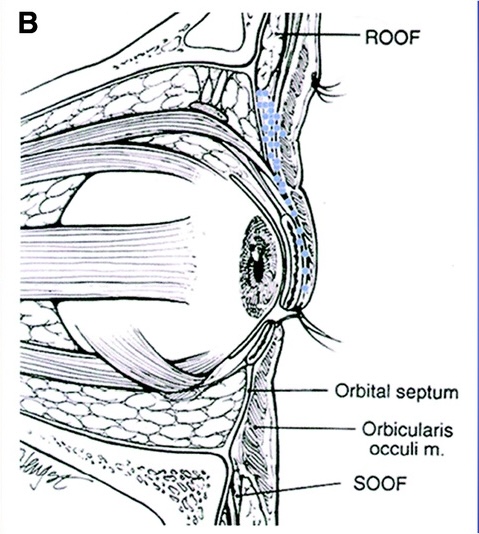
Lower eyelid contour concerns may involve fat, the orbital septum, skin, and the transition to the cheek.
Who may read this information: Patients whose lower eyelid anatomy may be addressed through a carefully selected approach after examination.
How the technique is considered: An upper-eyelid approach can provide access to selected lower eyelid structures in a coordinated procedure. The route is considered only when it is anatomically appropriate and may be combined with other eyelid work.
Connecting eyelid anatomy
The upper and lower eyelids are part of one orbital system. In selected cases, the surgical route can be designed around that relationship.
The plan must still address lower eyelid support, contour, and skin quality.
Choosing the route
The approach is selected after examination and a discussion of scars, recovery, risks, and the possibility that a more traditional route would be safer or more effective.
Potential benefits and limitations
- Links treatment planning across the upper and lower eyelid
- May avoid a separate lower eyelid skin incision in selected cases
- Focuses on contour and tissue relationships
Limitations: This is not an approach for every patient. The appropriate route depends on anatomy, prior surgery, skin laxity, and the desired correction.
Recovery: Recovery reflects the tissues treated and any combined operation. Bruising, swelling, dry eye symptoms, and temporary tightness may occur.
Consultation: Consultation includes a review of lower eyelid bags, hollowing, skin laxity, prior surgery, ocular surface symptoms, and alternatives.
Questions patients ask
Frequently asked questions
Is this approach used for every lower blepharoplasty?
No. The approach is reserved for selected anatomy and depends on the tissues that need treatment.